What Lithuanian small business can learn from Norway
We were born in Kaunas. We have fifteen years in digital marketing and content production, eight of them spent living and working abroad — in the United Kingdom and Norway. Our base is back in Kaunas now, and we apply the same method here.
The agency is new — the team is not. And this piece is not about how wonderful Norway is. It is about a few very concrete habits that even the smallest companies have there, and why Lithuanian businesses without them often stay invisible — despite doing work that is every bit as good.
What a five-person company looks like in Norway
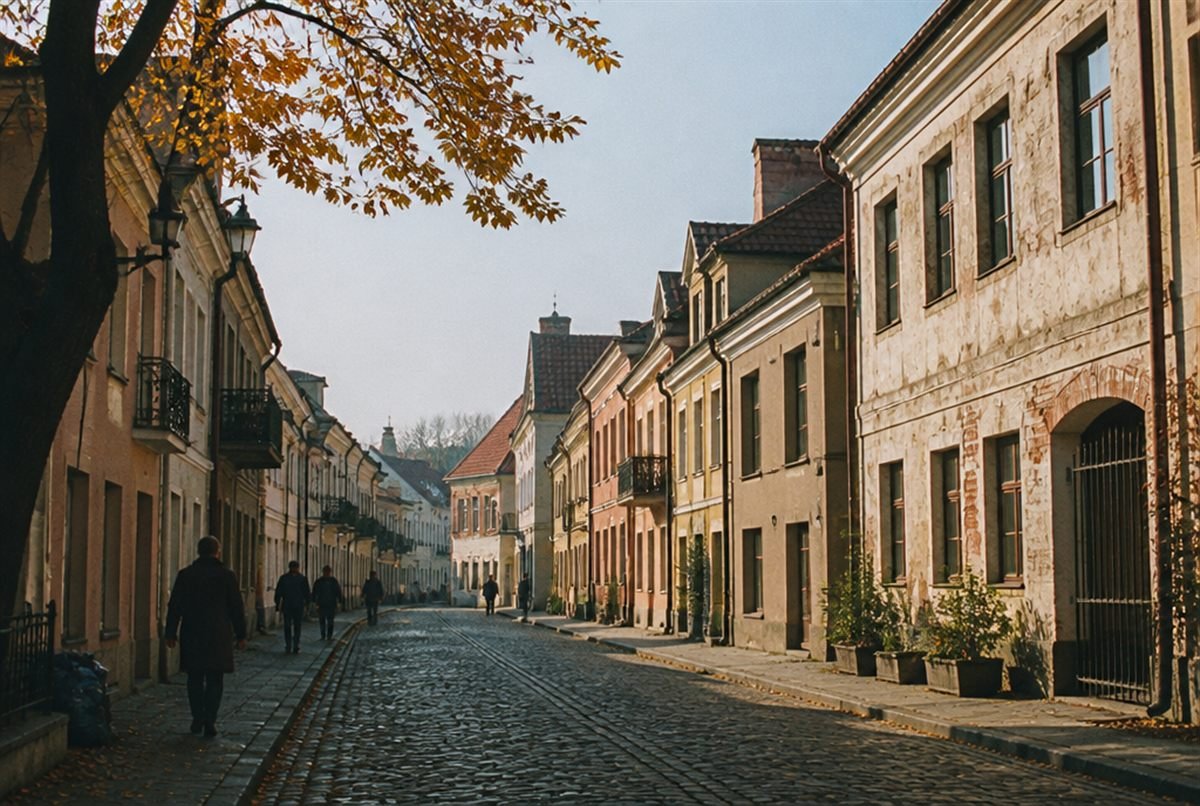
A small Norwegian business tends to look roughly like this. Five people, one or two services, one region. And alongside that: a tidy website that clearly states what they do and roughly what it costs. A Google Business Profile with a few hundred reviews. Advertising where every euro is tied to a specific enquiry.
This is not the exception, and these are not the market leaders. This is the average. A plumber, a moving company, a cleaning service, a small garage — they all work more or less this way, because otherwise they would not survive there.
Now compare that with what we see back home. In Lithuania we meet companies that work no worse at all. The craftsmen are better. The prices are fairer. The customers are happy. But from the outside they are almost invisible: the website is old or missing, there are four reviews, advertising was tried once and "didn't work" — and nobody knows why it didn't work, because nobody measured.
The difference is not quality. The difference is that in Norway somebody helped that business put a system in place, and in Lithuania nobody did. That is worth saying plainly, because a lot of owners assume they are missing talent or something fundamental. They are not. They are missing a few habits.
Measurement as a culture, not as a report
This is the single most important thing in this article. Norway is an expensive market. An hour of labour is expensive, advertising is expensive, a mistake is expensive. So a habit formed there that Lithuania still largely lacks: every euro spent has to be justified by a number.
In practice it sounds like this. Nobody pays for "visibility". Nobody pays for "building awareness". The two questions even the smallest business owner asks are: what does one enquiry cost me and what does one customer cost me. If there is no answer, the budget conversation simply does not happen.
The gap between those two numbers and everything else is enormous. Once you know an enquiry costs, say, eight euros, and that on average one in four enquiries becomes an order, you stop arguing about taste. You can see a customer costs you thirty-two euros, and you can answer the only question that matters: is my average order worth more than that. If yes — increase the advertising. If no — fix the offer, the website or the targeting. The decision takes a minute, not a month.
And here is the best part: this habit costs nothing. You do not need tools at several hundred euros a month. You can start with a spreadsheet with three columns — where the enquiry came from, whether it became a customer, and the order value. Two weeks of that spreadsheet tells you more than a year of gut feeling. Almost everyone who starts notices the same thing after a month: the money was going somewhere other than where the customers come from.
Honestly — measurement does not make marketing better by itself. It only shows you the truth. But without the truth you cannot make a single sound decision, and with it even average advertising becomes sensible within a couple of months.
Reviews are currency
In Norway reviews get checked before almost everything. Before calling a plumber. Before booking a move. Before taking a child to the dentist. It is not a whim — it is the normal way to reduce risk in a market where services cost a lot.
But the interesting part is not that customers read reviews. The interesting part is that asking for them is normal. When a job is finished the customer gets a short message: thanks, if you were happy it would mean a lot if you left a review, here is the link. Nobody takes offence. It is considered as much part of the job as sending the invoice.
In Lithuania most businesses find this step uncomfortable. We hear it constantly: "I don't want to be pushy", "if they want to, they'll write one themselves". The result is a company that has traded for twenty years with seven reviews, and a competitor a year old with a hundred and twenty. The customer choosing on their phone sees exactly that, and decides in three seconds.
The reality is simple: happy customers rarely write on their own. Unhappy ones always do. So anyone who doesn't ask is systematically collecting a distorted picture of themselves. Asking is not manipulation; manipulation would be buying reviews or hiding the negative ones. Asking someone who genuinely enjoyed the work is just letting reality show.
We wrote about how to do this properly and without pressure separately: how to get more Google reviews ethically. One tip from experience: ask the same day the work finishes, while the customer can still feel the result. A week later you get several times fewer replies.
A website is a salesperson, not a brochure
Norwegian small-business websites are rarely beautiful. But they are almost always clear. The first screen says what the company does and who for. There is a price, or at least a price range. There is one simple way to get in touch — a short form or a phone number, visible immediately. And that is it.
In Lithuania we more often see the other model: the website as a brochure. A nice photo, a paragraph about "many years of experience and an individual approach", an "about us" section, and for the price — "get in touch and we'll agree". A page like that sells nothing, because the person who opened it leaves with exactly as much uncertainty as they arrived with.
The price question is especially sensitive in Lithuania. We hear that prices can't be shown because competitors will see them, or because every job is different. Competitors already know your prices — a phone call is enough. Meanwhile the customer who finds no number at all usually draws the simplest conclusion: probably expensive. And closes the page. A price range with a short note on what the final figure depends on solves this completely — and filters out the people who were never going to buy anyway.
The second thing is the path to contact. If submitting an enquiry means filling in ten fields or hunting for an email in the footer, a share of people leave. A name, a phone number and one sentence about what they need is entirely enough. You can ask the rest during the call.
We described what such a website looks like in practice here: website development.
Consistency beats campaigns
The most common pattern we see in Lithuania: a business does nothing for years, then decides to "get serious about marketing", spends a large sum on one campaign over two months, gets a handful of enquiries, is disappointed, and returns to the starting point for another two years.
Norway runs on the opposite rhythm — boring and steady. The same modest budget every month. A few new reviews every month. One updated page on the website every month. A quarterly look at the numbers, cutting whatever isn't working. Nothing impressive, but after twelve months that company is in a completely different position than the one that made a single big leap.
The reason is technical, not philosophical. Advertising systems need data to learn who to show ads to — and a campaign that lived for three weeks never accumulates it. Search visibility grows gradually. Reviews build up steadily. Everything in this field that produces results rests on time rather than intensity.
The practical conclusion for a small budget is unexpectedly pleasant: two hundred euros a month for a whole year beats two thousand euros once. Same money, completely different outcome.
What Lithuania genuinely does better
This section matters, because without it the article would be dishonest.
Advertising here costs several times less. The same budget in Lithuania buys considerably more clicks and considerably more enquiries than in Norway. A Norwegian company with the same monthly budget as a Lithuanian one often gets several times fewer contacts. Which means that in Lithuania even a modest budget can produce real traffic — as long as it is pointed in the right direction.
Decisions are made faster. In Norway approving a proposal can take weeks, because several people have to agree. In Lithuania you often speak directly to the owner, who decides during the conversation. In marketing, speed is an advantage: whoever tests faster finds what works faster.
The customer relationship is closer. Lithuanian small businesses often know their customers personally, remember their names, fix a small thing without charging. Service in Norway is orderly but more often formal. That closeness is a genuine asset — it is just almost never told publicly. It is a story that belongs on the website and in the reviews, not only among friends.
Less bureaucracy and lower costs. Running a company, accounting, organising work — all of it is simpler and cheaper. Which means a mistake costs less here, and you can afford to experiment more boldly.
Put it all together and the conclusion is fairly surprising: Lithuanian small business has better conditions than its Norwegian counterpart. Cheaper reach, faster decisions, closer customers, lower risk. What is missing is not opportunity and not ability — it is the system that ties all of it into one consistent process. Over there, everyone has that system. Here, almost nobody does.
Five things you can do yourself this week
None of them needs an agency and none of them costs money.
- Start a simple enquiry spreadsheet. Three columns: where the enquiry came from, whether it became a customer, and the amount. Fill it in daily. After a month you will have what you don't have now — facts.
- Ask your last five happy customers for a review. A short message with a direct link, the same day the work finished. Nothing more is needed.
- Open your own website on your phone and read the first screen. Within five seconds, is it clear what you do, who for and roughly for how much? If not, rewrite that one paragraph. It is the single sentence that changes the most.
- Put up a price, or a price range. For at least one main service, with a short note on what the final figure depends on.
- Tidy up your Google Business Profile. Opening hours, services, real photos, the correct phone number. It takes half an hour and for most local businesses it delivers more than any advertising.
If over the next month you do only these five things and nothing else, you will already be ahead of most of your competitors. Everything else — advertising, content, search visibility — is built on this foundation, not instead of it.
Questions we get about this
Do Norwegian methods actually suit Lithuania?
Where should I start if my budget is small?
Do I really need to measure? I can feel how things are going.
How long before I see a difference?
Is your business ready for serious growth?
Get in touch. As your strategic growth partner we take care of all your marketing — so you and your team can focus on what you do best.
- Strategy and execution in one place
- You do your work — we grow your pipeline
- Clear pricing, no long contracts
Or reach us directly: info@pakamedia.lt